What Temperature Is Beef Cooked at Medium Medium Well Medium Rare Well Done All of That
Steaks are delicious when cooked to the exact caste of doneness that you lot want. Nosotros accept all the answers you need to know nearly steak doneness, temperature guides and charts, the best thermometers, and impact exam.
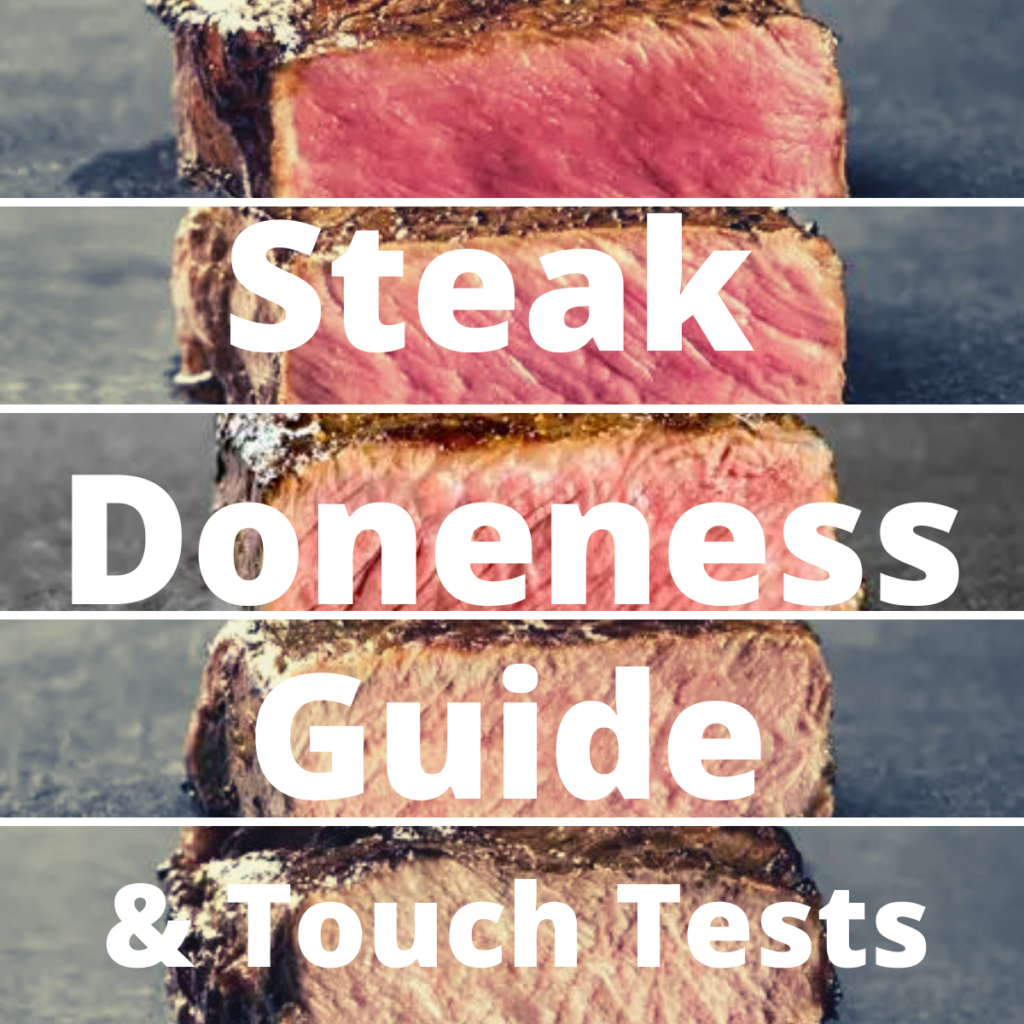
Ah, steaks. There'south zilch similar them. But, what is the best steak doneness? Rare? Medium? Well-done? And an fifty-fifty better question is how can you accomplish the best steak doneness from your own kitchen?
No affair how you like your steak, there are a few tips and tricks that will help y'all make the perfect steak every fourth dimension.
What are the degrees of doneness for steak?
Y'all've probably heard the terms for doneness before. The terms "rare," "medium rare," "medium," "medium-well", and "well" depict how meat is cooked. Just, did you know their definition goes beyond the color of the meat? For example, a medium-well steak is more than but, "only a petty pinkish in the middle"
Steak doneness is about the steak'south temperature. It's not about the colour or visual appearance of the beef. The secret to nailing the perfect doneness every time is a quality meat thermometer (more than on that below).
The reason for this is because steaks have dissimilar thicknesses and characteristics based on the cut and quality. Therefore, they all cook differently and to achieve a "medium rare" filet steak is going to exist slightly dissimilar than a flank steak.
Why is steak doneness important?
Doneness affects the steak'due south flavor, texture and juiciness of steak. Since no one wants to swallow a tough, stale out piece of beef, steak doneness is disquisitional for any domicile chef making steak. When y'all learn how to cook a steak to the appropriate doneness, you'll be eating steakhouse steaks at home.
What is the best steak doneness?
Rare – 120-129°F
Rare steak has cool-to-warm red center, and soft, tender texture. The USDA does not recommend eating rare meat, nor do many restaurants. However, if this is how you want to cook your steak, it'due south an splendid choice for leaner steaks similar meridian sirloin or filet mignon that don't accept as much fat to melt.
When cooking a steak to rare, it'southward frequently seared on the outside at high temperatures (400°F) for a few minutes on each side. This results in a bright red middle. When touched, the meat is soft and has near no resistance to pressing with a finger.
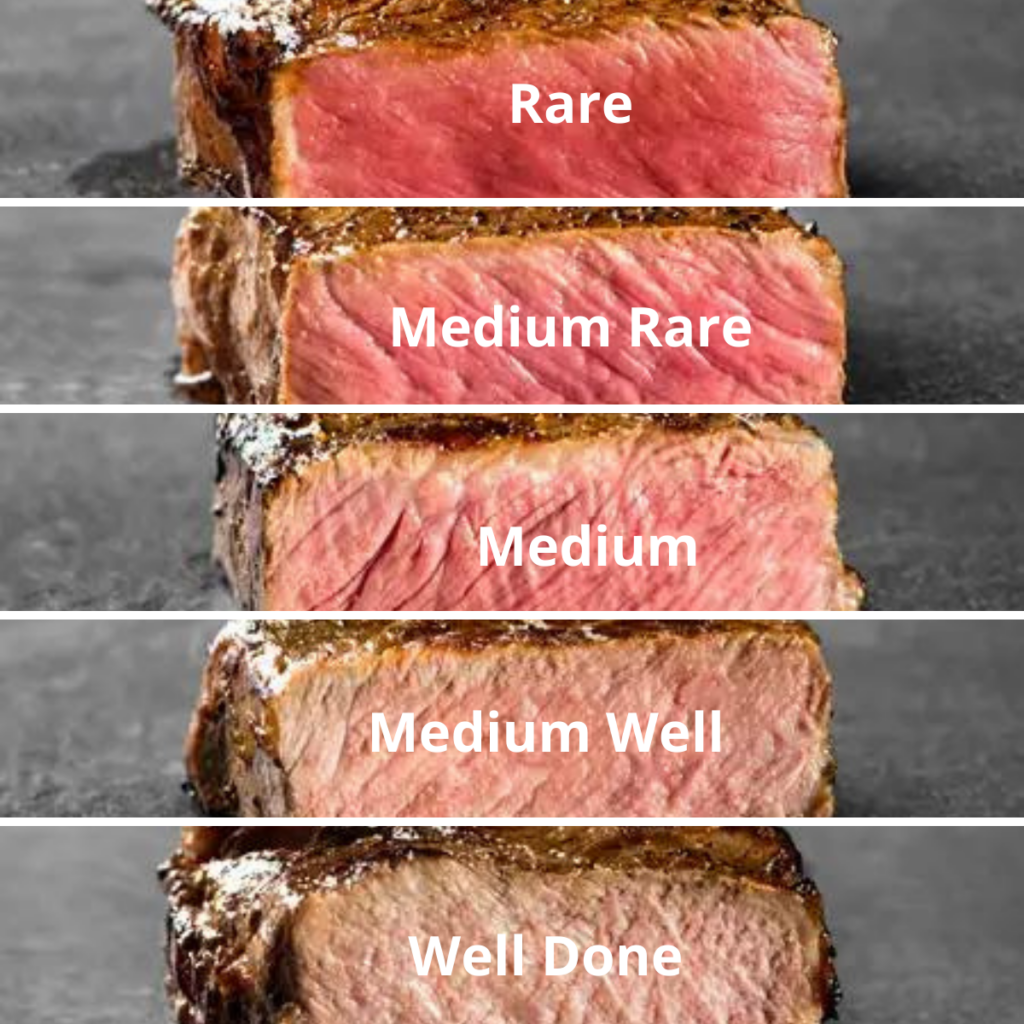
Medium Rare – 130-134°F
Medium-rare steak is the well-nigh popular level of doneness. Steaks served at this temperature are slightly warm, and have the best juiciness and texture. Medium-rare steaks are seared on the outside and the eye has a dark pink red colour. When touched, medium-rare steak gives only a slight resistance.
Medium – 135-144°F
A medium steak is also a very popular option. It has a pink center surrounded by chocolate-brown meat. Medium steak meets the USDA's recommended internal cooking temperature. A medium steak is completely warm and has no visible dark reddish in the center. Pressing on a medium steak with your finger gives slight resistance and it springs back a little.
Medium-Well 145-154°F
A medium-well steak will have a mostly brown center, with a faint pinkish color in the hot center. The meat will exist much drier and chewier because the juices inside the steak will evaporate during the cooking procedure. If you press on it with your finger, it will be firm with a considerable amount of spring.
Well done -155-164°F
We don't recommend cooking a steak to well-washed because it becomes chewy and has very piddling season. At this level of doneness, the beef loses all of its natural juices and the steak shrinks. The color will exist entirely dark-brown with no pink. When touched, it will exist firm and springy to the touch on.
Steak Doneness Chart
| Doneness | Temperature | Description |
| Rare | 120-129°F | Cool, brilliant red heart Soft to the touch |
| Medium Rare | 130-134°F | Warm red center Beginning to house upwards with cherry juices |
| Medium | 135-144°F | Warm pinkish center; outer portions beginning to brownish Completely firm to the touch with reddish juices |
| Medium Well | 145-154°F | Slightly pink center Completely firm to the touch with brown juices |
| Well Done | 155-164 °F | No pinkish or ruddy House to touch |
| Ground Beef | 160 °F | Fully brown throughout with no pinkish |
Note: The temperatures in this chart are final doneness. You need to pull your beef off the heat about 5-x°F earlier these temperatures are reached.
How to tell when steak is done?
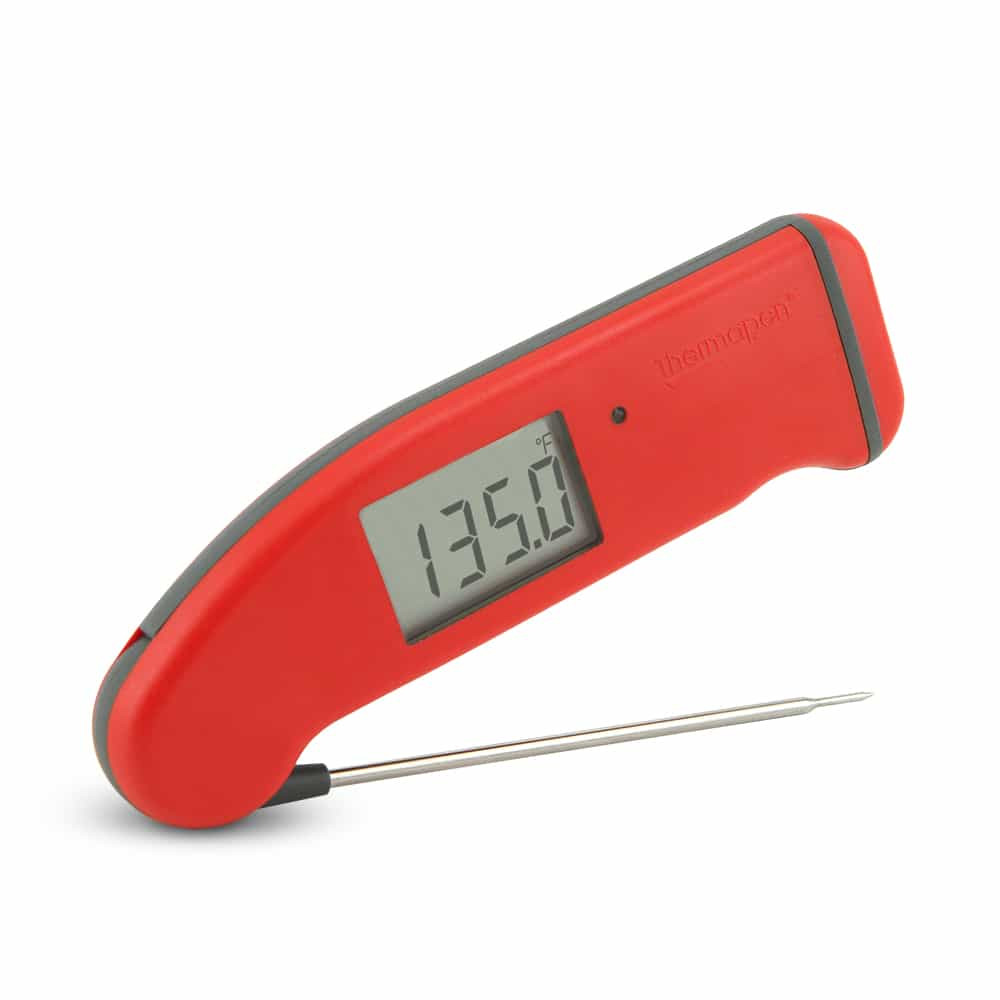
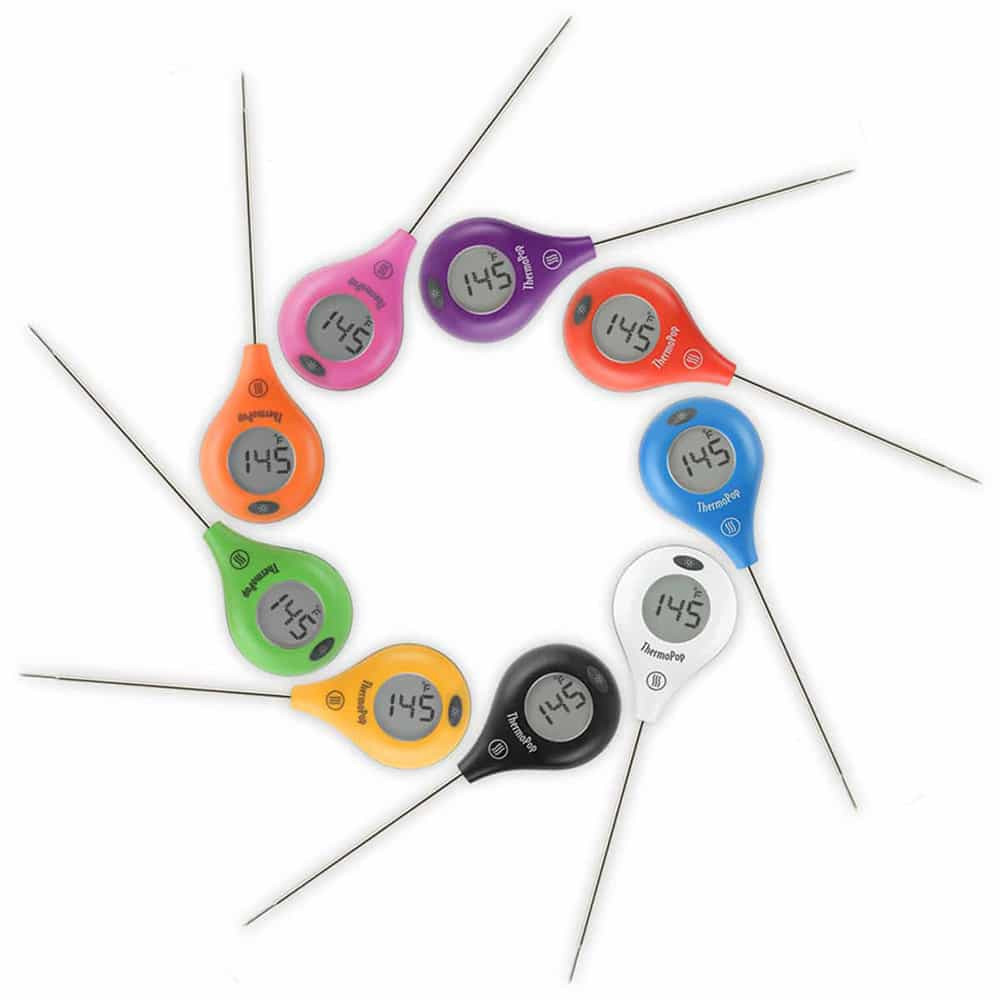
There'southward just 1 style to tell when steaks are done to the appropriate doneness – an instant-read digital meat thermometer.
Every kitchen needs a quality meat thermometer. Menstruum. (Equally a side note, we've tried dozens of thermometers and this is our favorite. Information technology's the best past far.)
When taking a temperature reading, mensurate in the center or the thickest part of the beef, not touching bone or fatty. For steaks 1/2 inch or thicker, it's ordinarily best to insert an instant-read thermometer horizontally from the side.
Carryover Cooking
Another tip to achieve the perfect steak at home is to exist mindful of carryover cooking, which is the ascent in the steak'southward temperature once it leaves the heat source.
When you take a temperature reading of steak, you're not looking for the specific number in the chart above. Rather, you desire to pull your steaks off at a high enough temperature so that carryover cooking will do the remainder of the work and enhance the temperature of the steak to your desired doneness.
This ways it'due south best to pull your steaks off the oestrus source when the thermometer reads about v-10°F lower than the desired doneness.
Let it Rest
All cooked beefiness needs to rest before serving. The reason for this is because meat is a muscle with 2 main parts – protein and water. When steak is cooked, the muscle fibers contract considering of the increased temperature. Then, the h2o is squeezed out of the fibers and the liquid moves towards the heart of the steak.
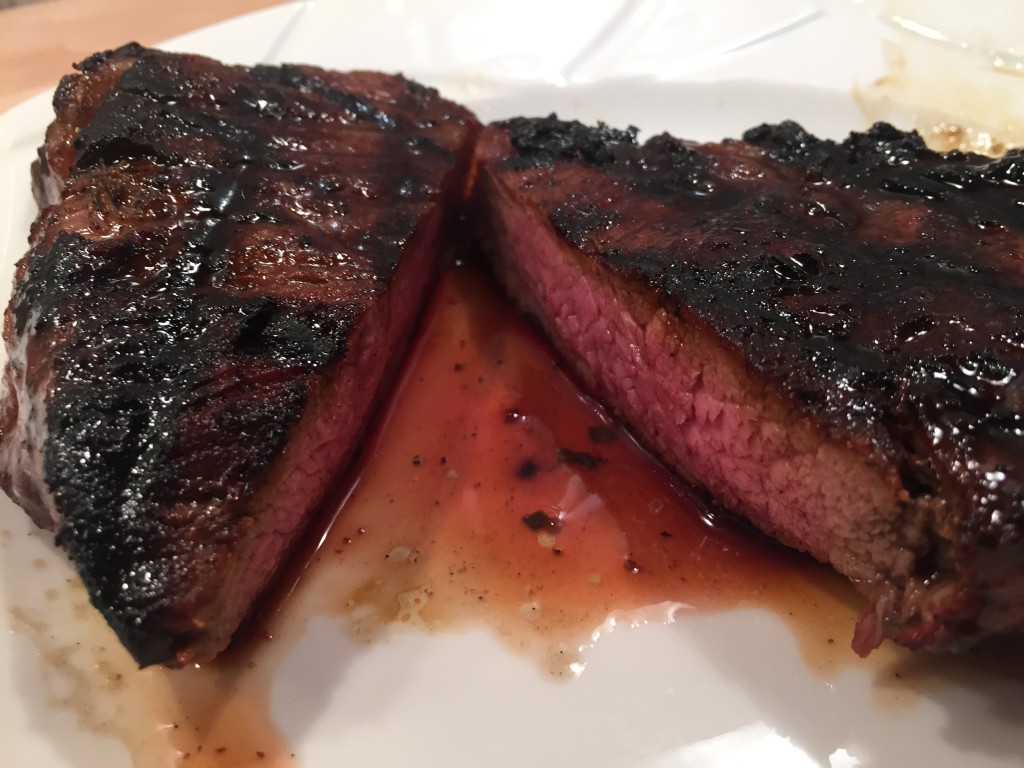
If meat is cut earlier it rests, the juice goes directly on the plate because the juices haven't had a chance to be reabsorbed past the meat notwithstanding. When steaks are removed from the heat and given a chance to residuum, the muscle fibers relax and widen and allows the juice and wet to redistribute throughout the meat.
There are different guidelines near how long should steak rest. Some say five-minutes for every inch of thickness, others say 10-minutes for each pound of meat, and however others say for every bit long every bit yous cooked the meat. At our house, we let all steaks rest 5-7 minutes.
Impact Tests for Steak
Considering steaks muscles widen and relax in the cooking process, the meat gets firmer the more done information technology is. This makes information technology possible to touch the steak and guesstimate its doneness. Bear on tests are very subjective, merely they're popular with some cooks. These tests are great when you're in a pinch, only recall, the only real way to tell a steak's doneness is by temperature, which requires a thermometer.
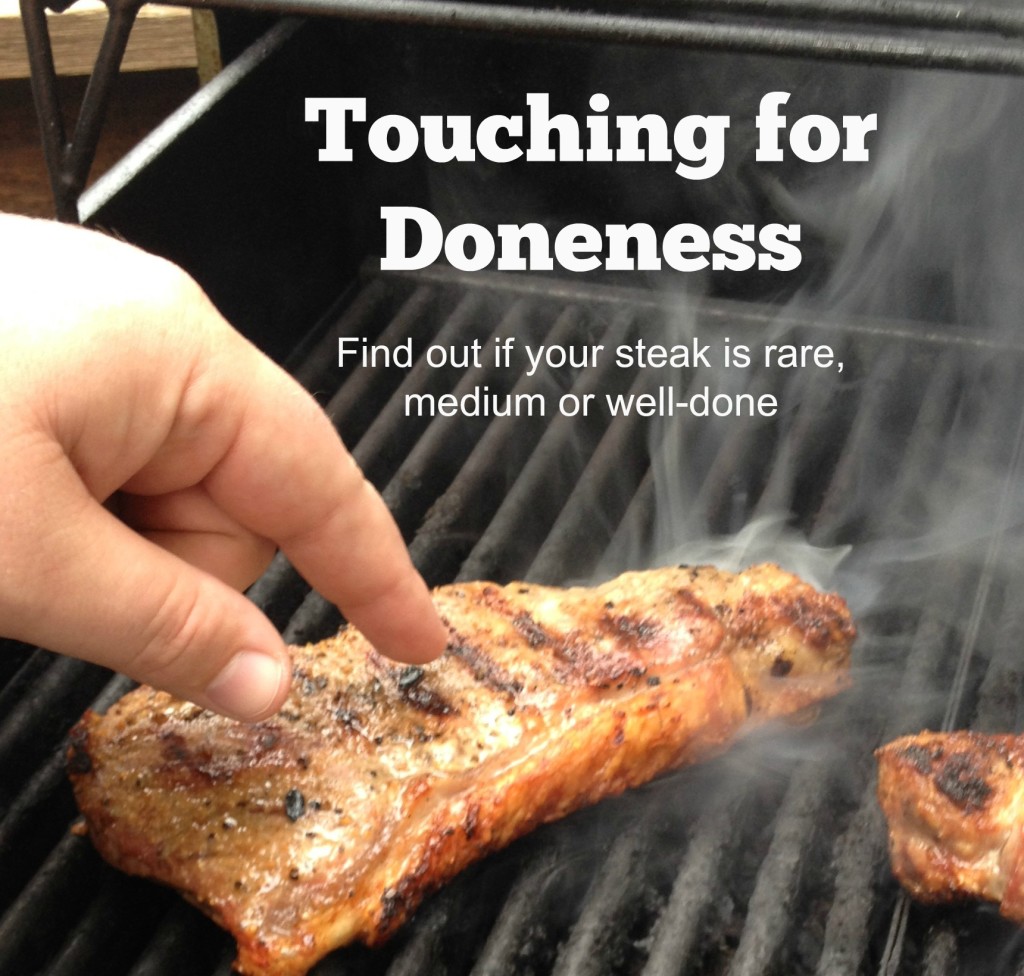
Impact Exam Method 1: Palm of your Hand
Hold your hand out, palm up. Poke the base of your manus by the base of the thumb. What does information technology feel like? If you guessed raw meat, you're correct.
Now, make an OK sign with your mitt by touching your forefinger and pollex together. Feel the same part of your hand. Information technology's a picayune firmer. This is how meat feels when information technology's rare.
You lot're now going to move to your other fingers, and as yous do, you'll notice the pad of your hand will get progressively firmer.
Touch on your middle finger to the tip of your thumb. That's how a medium rare steak feels.
Next, touch the tip of your ring finger to your thumb. This is what a medium-well will experience like.
Last only not least, bear on your pinky to your thumb. That's the equivalent of a well-done steak.
Touch Examination Method 2: Make a Fist
You can likewise practice a bear upon test by making a fist.
Starting time, make a relaxed fist. The fleshy area of your hand between your thumb and forefinger is soft, which is how a rare steak feels.
If you slightly clamp your fist, it's a petty firmer like medium doneness.
Clamp your fist tightly and the area will feel like well-done.
Touch Exam Method 3: Confront Test
Your tertiary option is the confront exam. Personally, we like methods 1 and ii the all-time, but some people really similar touching their face.
When your face is relaxed (don't smile), bear on your finger to your cheek. A rare steak is soft like your check
Next, bear upon your mentum. Detect that it's fleshy with some resistance. This is similar to medium doneness.
If yous like a steak that's medium, or with a pink center, you'll want information technology will be similar to when you bear on the finish of your olfactory organ.
Lastly, touch your forehead, information technology'southward firmer, which is similar well done.
Choosing the right steak
All steaks are dissimilar and have dissimilar qualities. Some steaks are known to be lean and others are known to be tough. Some usually accept a bone and others don't. These differences make information technology important to choose the correct cooking method with the cut of beef. Hither's a quick overview of each cut and the best cooking method:
Ribeye Steak
A Ribeye Steak is a tender and flavorful steak that has the nearly marbling of any steak. It is cut from the rib area just behind the shoulder. For this cut of beef, less cooking time results in a more tender steak. Grill, broil or pan sear this cut.
Strip Steak
A Strip Steak is a steakhouse archetype and an accommodating favorite. It'south known for mild marbling, tenderness and season. Strip Steaks are lean with a fine, tight grain that makes them moderately tender. Grill, broil or pan sear this cut.
Tenderloin Steak
A Tenderloin Steak is the most lean, tender and expensive steak. It's known for its buttery texture that volition cook in your mouth, simply it's non very flavorful. It cooks much faster than other cuts since it's so low in fat. A whole tenderloin can be cut into dissimilar steaks: a Filet is 1-ii inches thick, Chateaubriand is 3-inches thick. Grill, broil or pan sear this cutting.
T-bone Steak
The T-Bone is a combination of two steaks – Tenderloin and Strip – and the "T" shaped os is what divides the beefy strip and tender tenderloin. A T-Os and Porterhouse are very like, simply a T-Bone is slightly smaller. Grill, broil or pan sear this cut.
Sirloin Steak
Sirloin is the big central section of beef in the hip section of the animal, just ahead of the rump. A Sirloin Steak is a lean, inexpensive cut that makes it an all-effectually favorite. In add-on to being a great steak, it's besides ideal for kabobs and stew meat. In that location are two sirloin areas – lesser and superlative. Grill, broil or pan sear this cut.
Tri-Tip Steak
The Tri-Tip gets its name from its triangle shape. There is typically only one Tri-Tip on an brute, so it'southward non a common cut of beef. It comes from the bottom sirloin and is a well marbled cut that has a mild flavor. Grill, broil, stir-fry, or pan sear this cut.
Round Steak/Cubed Steak
A Top Round Steak is from the back leg and rump section of the beef. The meat has a very adept beefy flavor, only it can exist tough. Often times Round Steaks are sold as a tenderized steak. They are unremarkably big steaks, and 1 steak can oft feed ii people.
Brim Steak
A Skirt Steak is a thin, flavorful cut of beef that'southward from the diaphragm area. This cutting is platonic for fajitas. Grill, stir-fry, or pan sear this cut.
Flank Steak
Flank Steak is very distinct because of grains that run the length of the cut. Information technology's a lean and flavorful cut that can sometimes be slightly chewy. It's a thin cutting that volition cook quickly, so it's platonic for a weeknight meal. Grill, stir-fry, or pan sear this cut.
Hanger Steak
There is simply i hanger steak per creature and information technology'due south a flavorful cutting. The hanger steak has a singled-out expect and is pointed and thinner at one end. Grill or pan sear this cut.
Practise Makes Perfect
The perfect steak is only a few minutes abroad. Catch a thermometer and your favorite cut of beefiness, and start cooking! Cook steak regularly to larn the unlike cooking methods and y'all'll exist eating steakhouse steaks at habitation in no time!
Products we love
One More Thing!
If you're in the St. Louis area and y'all want to society beefiness from our farm, allow u.s.a. know. Were here to help!
Practise you desire to learn more about beef? Here are a few other beef posts and recipes you lot may similar. Plus, nosotros have an entire ebook about beef that goes through purchasing and preparing beefiness from a farmers perspective.
And here are a few other weblog posts you lot may like:
- What everybody ought to know almost beef cuts
- Ownership a Cow. How Much Beef Is It?
- Is It Done However? The Best Meat Thermometer
- How Nosotros Raise Our Grass Fed Beef
- Defrosting Meat: 4 Rubber & Like shooting fish in a barrel Ways
- Dull Cooker Pepper Steak
- Prime Rib Roast with Garlic Herb Butter
We participate in the Amazon Services LLC Assembly Programme, an chapter advertizement program designed to provide a ways for usa to earn fees by linking to Amazon.com and affiliated sites. Run across our disclosure policy for more details.
Source: https://www.clovermeadowsbeef.com/touch-test-steak-doneness/
0 Response to "What Temperature Is Beef Cooked at Medium Medium Well Medium Rare Well Done All of That"
Postar um comentário